From Scans to Avatars: The New Face of AI-Powered Healthcare
Author: /
Released:December 4, 2025
It feels like we’ve been hearing about "the future of medicine" for years, but the tools we’re seeing now are different. They aren't replacing doctors; they're helping them catch what the human eye might overlook and trimming 40% off the time patients spend waiting for care. If you're wondering how the industry is actually changing, it starts with these practical, day-to-day wins.
1. The Invisible Medical Revolution
Healthcare costs are skyrocketing, but a quiet efficiency hack is taking over. AI and healthcare are no longer separate entities; they are merging to eliminate the "busy work" that burns out doctors and drains patient wallets. We are seeing a shift from reactive treatment to proactive prevention.
For most patients and providers, the goal is simple: better results for less money. By leveraging generative AI in healthcare, institutions are automating clinical notes and predicting patient risks before symptoms even appear. This isn't just about tech—it’s about reclaiming time and resources.
2. AI Power Medical Imaging: What Is It?
One of the most frequent questions from investors and tech-seekers is: Can AI power medical imaging? Simply put, it is the use of deep learning algorithms to analyze X-rays, MRIs, and CT scans with superhuman precision.
These systems act as a "second pair of eyes" that never gets tired. For example, AI can identify early-stage lung cancer or neurological shifts months earlier than traditional methods. Companies like GE HealthCare are already deploying these tools to reduce diagnostic errors and speed up the journey from scan to treatment.
3. Telehealth’s New Face: The Rise of AI Avatars
Remote care used to feel cold and impersonal, but that is changing fast. Startups are now hunting for the best AI avatar creators for telehealth consultations to bridge the gap between human empathy and digital efficiency.
These life-like avatars can conduct initial patient intake, explain lab results, or provide mental health support in multiple languages. They don't replace doctors; they act as high-level triage, ensuring that when a patient finally sees a human physician, the most critical data is already organized and ready.

4. Real-World AI in Healthcare Examples
Theory is fine, but where is the actual "loot"? Look at how AI for healthcare is functioning in the wild today:
Pathology: AI scans thousands of tissue slides to find a single cancerous cell.
Drug Discovery: Developing a new drug usually takes 10 years; AI is shortening that to months.
Operational Flow: Hospitals use AI to predict "peak hours," ensuring staff are where they need to be before the rush starts.
Platforms like Google Health are leading the charge in using AI in health care to organize the world’s health information, making it accessible and useful for everyday clinical decisions.
Comparison: Traditional vs. AI-Enhanced Healthcare
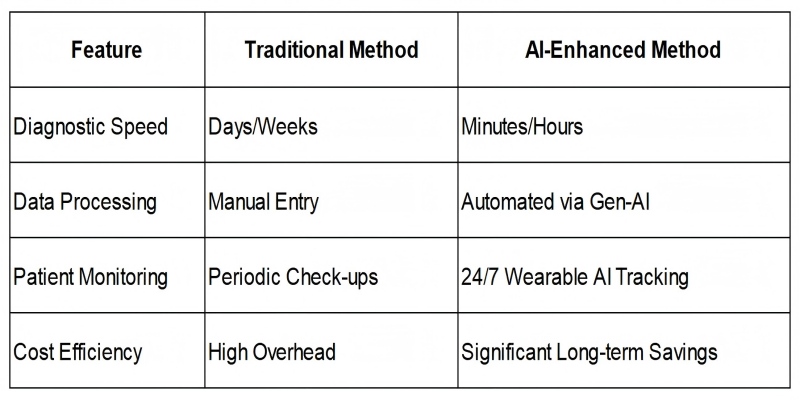
5. Generative AI: The New Administrative Hero
Documentation is the "hidden tax" of the medical industry. Doctors spend nearly half their day on paperwork. Generative AI in healthcare is solving this by transcribing conversations in real-time and generating accurate summaries.
This technology isn't just a convenience; it’s a massive commercial opportunity. By reducing the administrative burden, clinics can see more patients without increasing staff costs. It’s the ultimate "work smarter, not harder" play for the modern medical era [1].
6. Navigating the Risks: Privacy and Cost
Is it all sunshine and profits? Not quite. The biggest hurdles remain data privacy and the initial cost of integration. Using AI for healthcare requires strict adherence to regulations like HIPAA to ensure patient data isn't leaked or misused.
Furthermore, "hallucinations" in AI—where the system confidently provides wrong information—are a serious risk in a medical context. This is why the industry is moving toward "Human-in-the-loop" systems, where the AI suggests, and the human validates.
7. The Future: Investment and Integration
The market for AI in the medical sector is projected to grow exponentially through 2030. Investors are looking past the hype and focusing on "integration plays"—tools that plug directly into existing hospital software without requiring a total overhaul.
From Microsoft’s Nuance to niche AI startups, the race is on to see who can provide the most seamless user experience. If you are looking to save on healthcare costs or invest in the next big thing, the "early adopter" window is still open, but closing fast [2].

Summary of Clinical AI Benefits
Accuracy
In day-to-day clinical work, AI is most useful in tasks that require constant attention to detail. Imaging tools can review scans frame by frame without fatigue, helping flag small lung nodules, early bleeding, or subtle retinal changes that are easy to miss during long reading sessions. In most hospitals, these systems are used as an extra review layer, not a final decision-maker. The result is fewer overlooked findings and more time for doctors to focus on complex or high-risk cases.
Accessibility
AI also helps close the gap between large medical centers and smaller clinics. With AI-assisted imaging, basic triage tools, and automated follow-ups, facilities without full-time specialists can still offer a higher level of care. This has been especially practical in radiology, pathology, and mental health, where specialist shortages are common.
Efficiency
On the operational side, the gains are straightforward. Tools that handle transcription, visit summaries, and basic coding reduce the hours doctors spend on paperwork. Many clinics report shorter visits and smoother patient flow, often without adding staff.
Affordability
Cost savings tend to come gradually. Fewer repeat tests, earlier intervention, and better chronic care management help reduce downstream expenses over time, rather than relying on one-off cuts.
Final Thoughts
The transition to an AI-driven medical landscape is no longer a "maybe." Whether you are a provider looking for the best AI avatar creators for telehealth consultations or a patient wanting to understand how AI powers medical imaging works, the resources are available now.
You don't need to be a data scientist to benefit from these advancements. Most of these tools are designed to work quietly in the background, making your healthcare experience faster, cheaper, and more accurate. It is worth exploring the current market leaders to see which solutions fit your specific needs or investment profile.
References
[1] Artificial Intelligence in Healthcare - Harvard University
[2] AI in Healthcare Market Trends - World Health Organization